Leaving the Lab to Find Myself
![Writer: Emily [Guest Writer]](https://static.wixstatic.com/media/5c7114_b0d6b6af9b714e13ade91e54c8bc8bf0%7Emv2.png/v1/fill/w_32,h_32,al_c,q_85,enc_avif,quality_auto/5c7114_b0d6b6af9b714e13ade91e54c8bc8bf0%7Emv2.png)
What do you want to be when you grow up? That’s a question I have never known the answer to.
To give an accurate answer, I need to understand the question. When we are asked this as kids, we are expected to state the job of our dreams. We learn that what we are when we grow up is what we do for work.
So, when I grew up and I still didn’t know what I wanted to do for work, I felt like I lacked an identity.
Entering the workforce after university was daunting, especially when I didn’t know what my career would be. Initially, I was planning to apply to medical school with pressure from my family, but I realized healthcare wasn’t for me. I had known that deep down, but I ignored the feeling until it was time to confront it head on.
I wish I had looked inward to begin with to align my career path with my own identity, rather than another person’s vision for me. It felt like it was too late for that, and that I needed to work with what I had to develop some identity. So, as a recent biology graduate, I started to look for lab work to get my foot in the door and take my first step toward a career path.
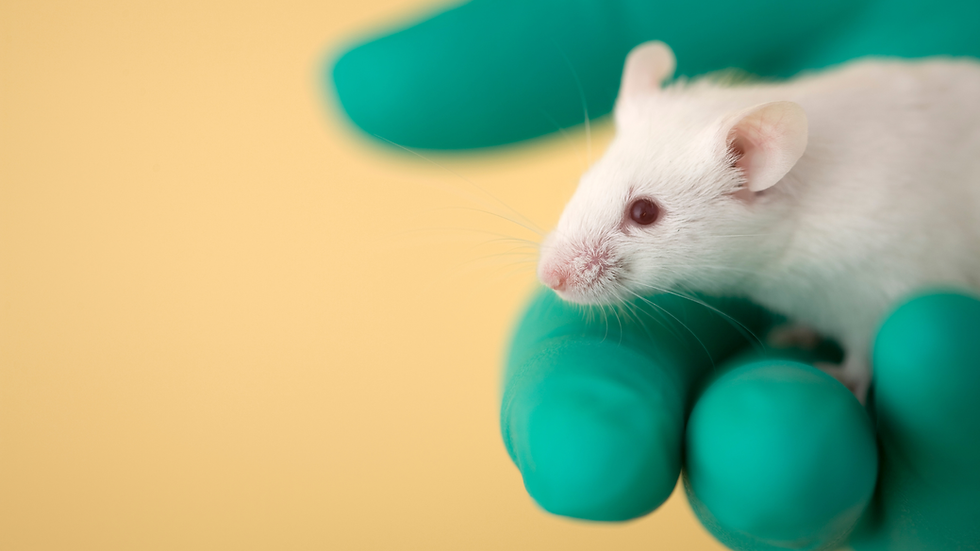
Finding a job was not easy for me. That’s why I was really excited when I got the opportunity to work in an oncology research lab with a referral from my friend. It was a meaningful and life-saving purpose that I was excited to become a part of. There was just one aspect of the job my friend warned me about: I would be experimenting on mice.
My friend advised me to prepare a response for the job interview about what I think of animal research and if I’d be comfortable testing on animals. I took her suggestion and thought carefully about how to word my answer. I wanted to make sure I didn’t sound emotional or sensitive. I felt that was necessary to give the impression that I was serious about science and wouldn’t let feelings get in the way of that.
Now that I think about it, I think that was the first time I justified what I was going to be doing to thousands of rodents, and it was before I was even introduced to one or was aware of what I’d be doing to them.

I had implicit trust that animal testing was, on the whole, conducted with great consideration of the living beings subjected to it.
I don’t know what I was expecting to see, but I know I wasn’t prepared for the routine suffering of animals I was exposed to and participated in. There was one cruel procedure that seemed particularly superfluous.
Working in the field, science and animal rights had always been presented as a dichotomy to me. I had no idea there was an entire emerging field dedicated to the discovery of new approach methods that don’t require animals.
I just had a really uneasy feeling that there was no way that so many animals needed to suffer through this barbaric procedure for the sake of science. It was expected that an animal would be screaming throughout, and it could go on for a few minutes. In fact, I was even taught that screaming was a good sign to ensure that the animal was still alive.
Each day I continued over the course of two and a half years, I got a bit closer to the
realization that I could not keep doing it. For a long time, I kept going because my job was my identity and without it I wouldn’t know who I was. As much as I wanted to keep convincing myself that the harm I was doing to animals was necessary for science, I couldn’t ignore the feeling any longer, and I left without having anything lined up.
I was terrified to be jobless and go back to square one, and while uncertainty is scary, I know now that my job is just one part of my identity. I never forgot who I was. I ignored my gut feelings for a long time, but they didn’t go away. They were just buried underneath layer after layer of cognitive dissonance. I couldn’t keep hiding from myself by adding more layers. It was time to let myself breathe, to be myself, and to figure out what I want to do with my time here on Earth.
I didn’t know what I wanted to do, but I knew I didn’t want to test on animals anymore, even if that was my professional skillset. I decided that I need to establish my identity, and build a career that aligns with that, not the other way around. I have started to gain back my momentum knowing I can love animals and science and not feel ashamed for it.
By discovering Justify, I found something I needed that I didn’t know existed – a community – for people affected by animal research. That was the moment I learned that it wasn’t just me. There were others who saw what I saw and feel what I feel, and it’s okay to talk about it. There is hope for a future where animal activism and scientific advancement are integrated. That is something I want to be a part of.